Again: Relevance, why Twitter?
See on Scoop.it – eLearning, Blended Learning and Mobile Learning

Twitter has been a topic for educational bloggers for several years now.
See on smartblogs.com
A series of tutorials/videos 5 minutes or less on Twitter in Education
See on Scoop.it – eLearning, Blended Learning and Mobile Learning
Twitter has become a powerful tool for teaching and learning. VideoAmy offers up a playlist of videos that will help you learn to use the social platform well in a variety of ways.
See on www.edutopia.org
Here’s the scoop on some Content Curation tools
I hear a lot about Content Curation in the Twitterverse and so I thought I’d play around with it for a while. Over the last month or so I’ve been working on editing an eLearning course, so I decided I would try one of the newer curators- Scoop.It!
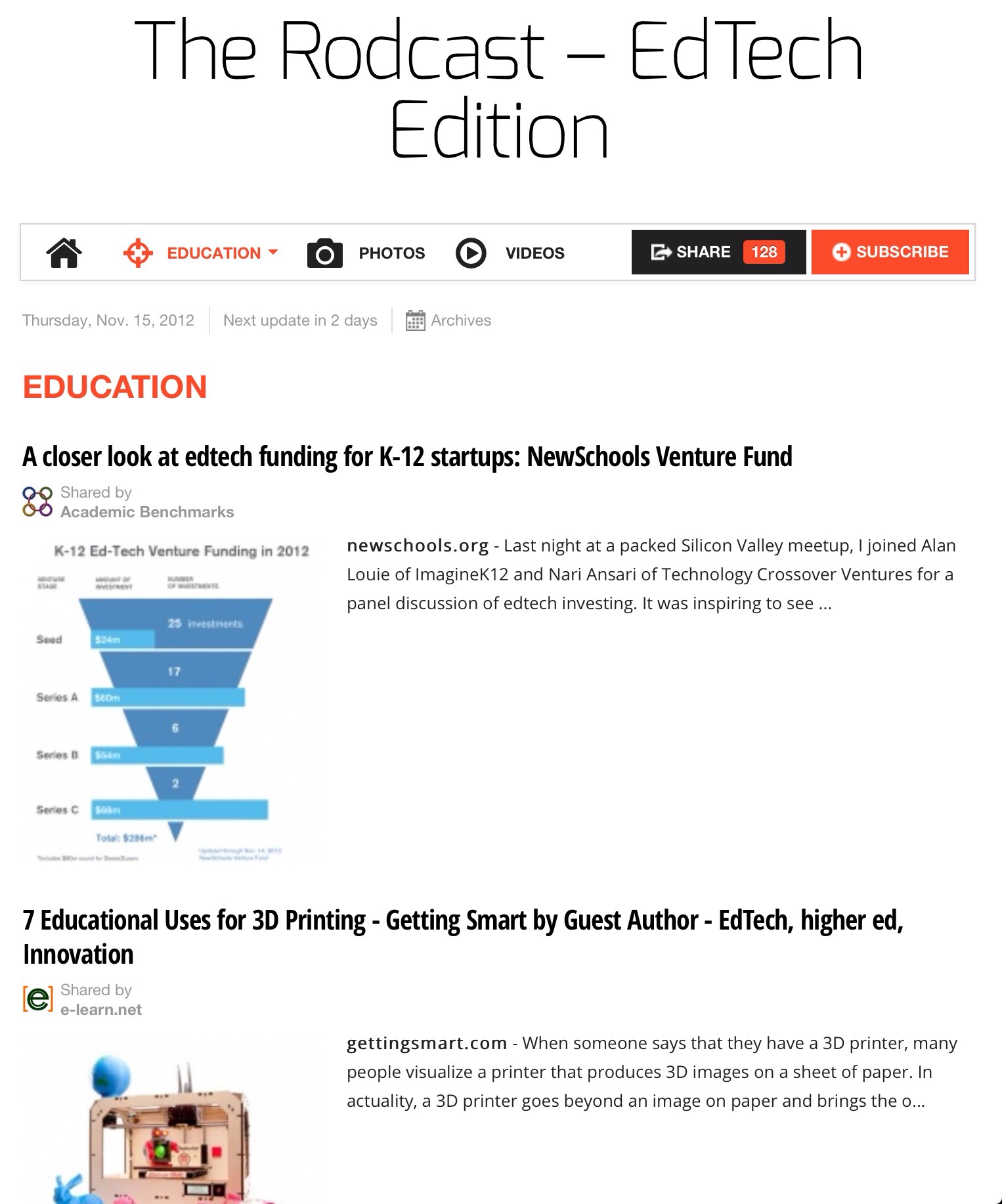
I’ve also used Livebinders and I’ve had a Paper.li account for quite a while. Livebinders are a great way to collect static web resources in one place. Paper.li collects content from your Twitter stream, hashtags and other sources and updates it on a regular basis. Content is controlled by your settings, but there’s less control than Scoop.it! I should mention good old RSS via Google Reader, where your good finds can be posted via Google+, which is quite a useful curator in itself.
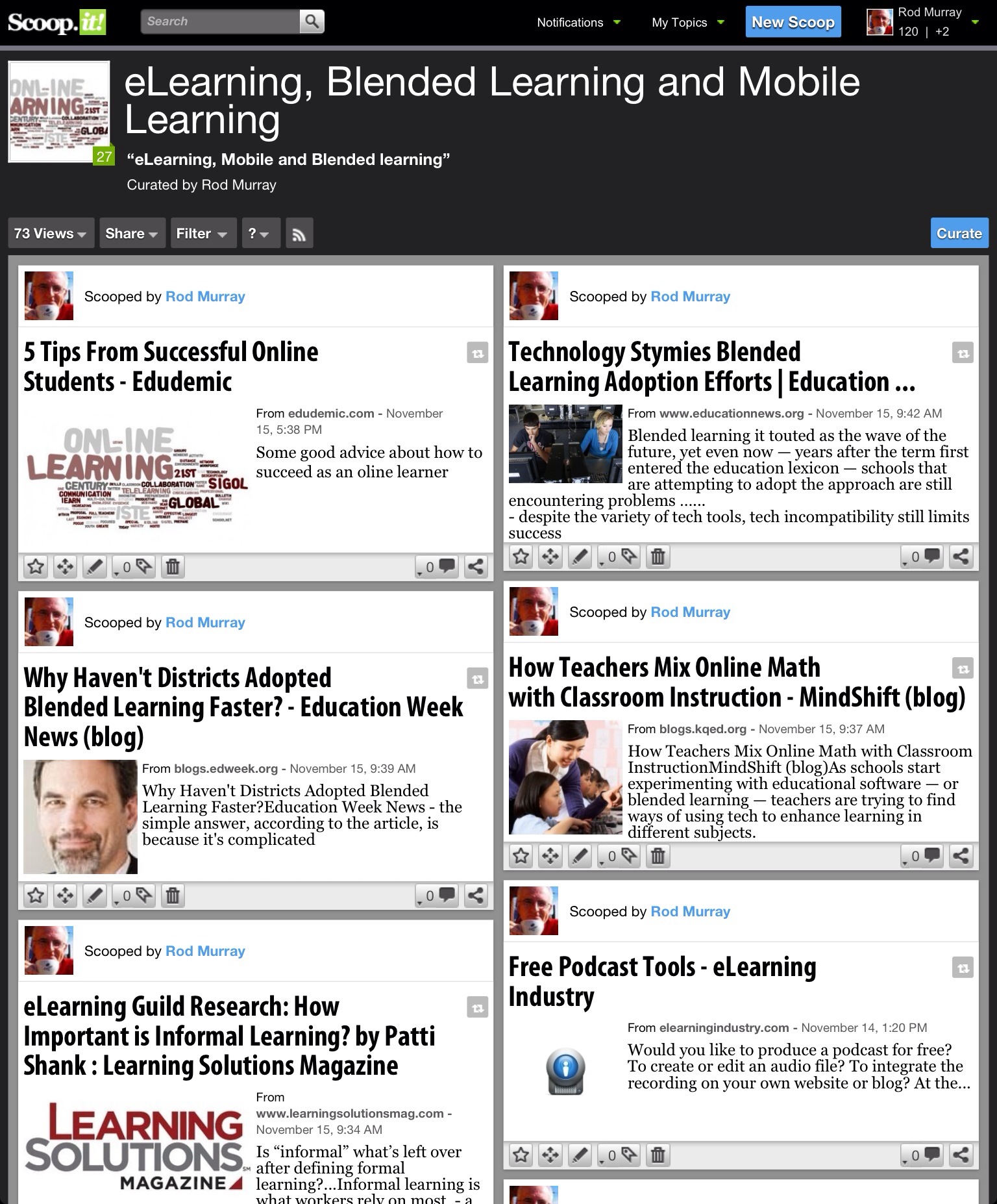
I really like Scoop.it! for the way it collects, assists you to curate, comment and add value to your content, and to share that content via a wide range of Social Media. There’s a Bookmarklet for immediate Scooping too! And there are more features that really make this a powerful tool. If you follow other people using Scoop.it!, you can scoop their scoops too and insert them into the topics you are curating. Add to this, powerful analytics that will tell you how many followers, rescoops, views and reactions your Scoop.it! has garnered, this is my ool of choice right now.
Pick a topic and get curating!
See on Scoop.it – Brain Based Learning and eLearning

See on mindsharelearning.ca
PLNs- Fiction or Reality?

My Personal Learning Network
But that’s not what happened.
My first idea was to poll my Twitter based PLN for their ideas:
Crowdsourcing the power of #PLN: Q-What’s the most significant/empowering/immediate thing learned from your PLN? Pls RT #powerpln #edchat
— Rod Murray (@mrmuzzdog) September 2, 2012
So far, I received a grand total of one (1) response!
@mrmuzzdog we are no longer the lone wolves #powerpln
— Jenny Ashby (@jjash) September 2, 2012
I really appreciated that Jenny Ashby, who is from Australia, and a recent addition to my PLN, took the time to fire back a short, but meaningful response. We were both attendees at Unplugd12, an educational summit of international educators who are promoting the power of PLNs in professional development. But it’s a busy time of year. Perhaps many of my Twitter colleagues were making the transition from summer to classrooms. Jenny, being “downunder,” was well into the 3rd term of the Australian school calendar.
The Power of the PLN, she suggested, comes from the fact that progressive educators are not alone, out on a limb, experimenting with untried ideas. Ironic, since she was the only one who replied! But we are, after all, educators that share. Networked educators. Our ideas are bounced off colleagues in the next classroom, the next school, the next province, or the next country. Or in Jenny’s case, a far away country.
A number of well known academics have been curious about PLNs too, the most well known to the Canadian ed tech community being Dr. Alec Couros, professor of Educational Technology and Media at the University of Regina. As far back as 2008, Dr. Couros has been wondering about the research related to PLNs. He is currently organizing a MOOC (Massive Open Online Course) on the topic of Educational Technology including the role of PLNs in open learning.
Will Richardson, well know educational technology blogger, published “Personal Learning Networks- Using the Power of Connections to Transform Education” in 2011. It’s a must read. In it, Richardson describes how networks are changing the way we learn, and how to leverage connections to transform learners, learning, teaching, classrooms and schools.
But there is a dearth, it seems, of hard research on PLNs. But I can tell you from experience that I have learned a significant number of things from the people in my online connected world. What do you need to know about PLNs? What is it that you would like to learn from your network connections? From whom, in particular, can you best learn it? I chose Educational technology as my PLN focus a few years ago and so I started reading the Blogs and following the Twitter feeds of as many Ed Tech leaders I could find. Virtual colleagues are as important as real ones. What face to face opportunities exist to learn about your area of interest? Conferences? Meetings? EdCamp Toronto on September 29th, York University?
It’s up to you and your PLN. Bring your questions to EdCamp! And that question I started with…experience suggests it’s a powerful reality.
So, how shall we then learn?
So, we attended Unplugd12 on the weekend, had intense personal experiences, shared our deepest thoughts, hopes and dreams about learning with like minded people and now we’re home safe from the wilds of Northern Edge Algonquin. What’s next? How shall we then learn?
The fact that we are all still processing what just happened will, no doubt, continue to create new learning, new points of view, new ideas that result from reading, thinking, analyzing and synthesizing the book we collaboratively wrote while we were there. For me, and maybe others, the connecting of these ideas will be a slow process, as I read through the various pages and chapters.
But already there are some pretty salient truths that emerged. Almost everyone brought to the event a deep passion for personal learning and teaching using the most current of technology tools. How can those tools enhance the learning that occurred for us, when we return to our teaching roles, whatever form they take? How can the experience of thinking, writing, editing, critiquing, organizing, linking, creating and publishing at Unplugd12 be used to model similar activities with the learners with whom we work? What’s your take away from that experience?
One very obvious outcome is the way we now read ones another’s tweets, blogs, emails and other written communication. We hear one another’s voices, both literally and figuratively. We have some deep connections to people from which we can gain inspiration, knowledge, skills and insights. How will we maintain, nurture and develop those connections in the near and distant future? Will our #unplugd12 hashtag be sufficient? Will we need to explore more immediate forms of communication to bounce ideas around one with another (I tried a Google + Hangout and invited all of the gang, with limited success, so what will work?) ? How can we connect our learners with the unplugd12 community?
Unplugd12 was a short, intense visioning exercise that must produce some obvious change in thinking and practice. For me, that change will be evident in the quality of online exchanges and more definitive boundaries in my PLN, with the hope that my specific learning goals for this year can be achieved. What about you?
Unplugd 12- First Thoughts
I just read Heidi Siwak’s post, and it’s not surprising that our first thoughts tend to be what we felt about the Place we spent time in such a powerful learning environment.
I have yet to process even a fraction of the things I learned, or relearned at #unplugd12, but I do want you to hear a big shout out to the Northern Edge staff who made it easy for me to get in touch with my former life at summer camp- paddling, woods, rain, good food, paddling, biking, more rain, stars, water, swimming, paddling, shooting stars, and awesome friends. Did I mention paddling?

I was in Quebec a few weeks ago and stopped in Drummondville, and was immediately reminded of a poem I had to memorize in Grade 5. It was by Irish doctor William Henry Drummond, who had emigrated to Quebec in the 1860’s at the age of 10. After living through oppressive poverty, he eventually attended school and became a doctor and travelled around Quebec, learning much about life as a Habitant. He wrote many poems in dialect, which, when read aloud using the phonetic spellings of the words, give life to the stories of people and places of the time.
Here’s my recitation of one I learned in Grade 5, that I was pleased to be able to recite at Unplug’d 12.
The Missing Word in PLN is “People”
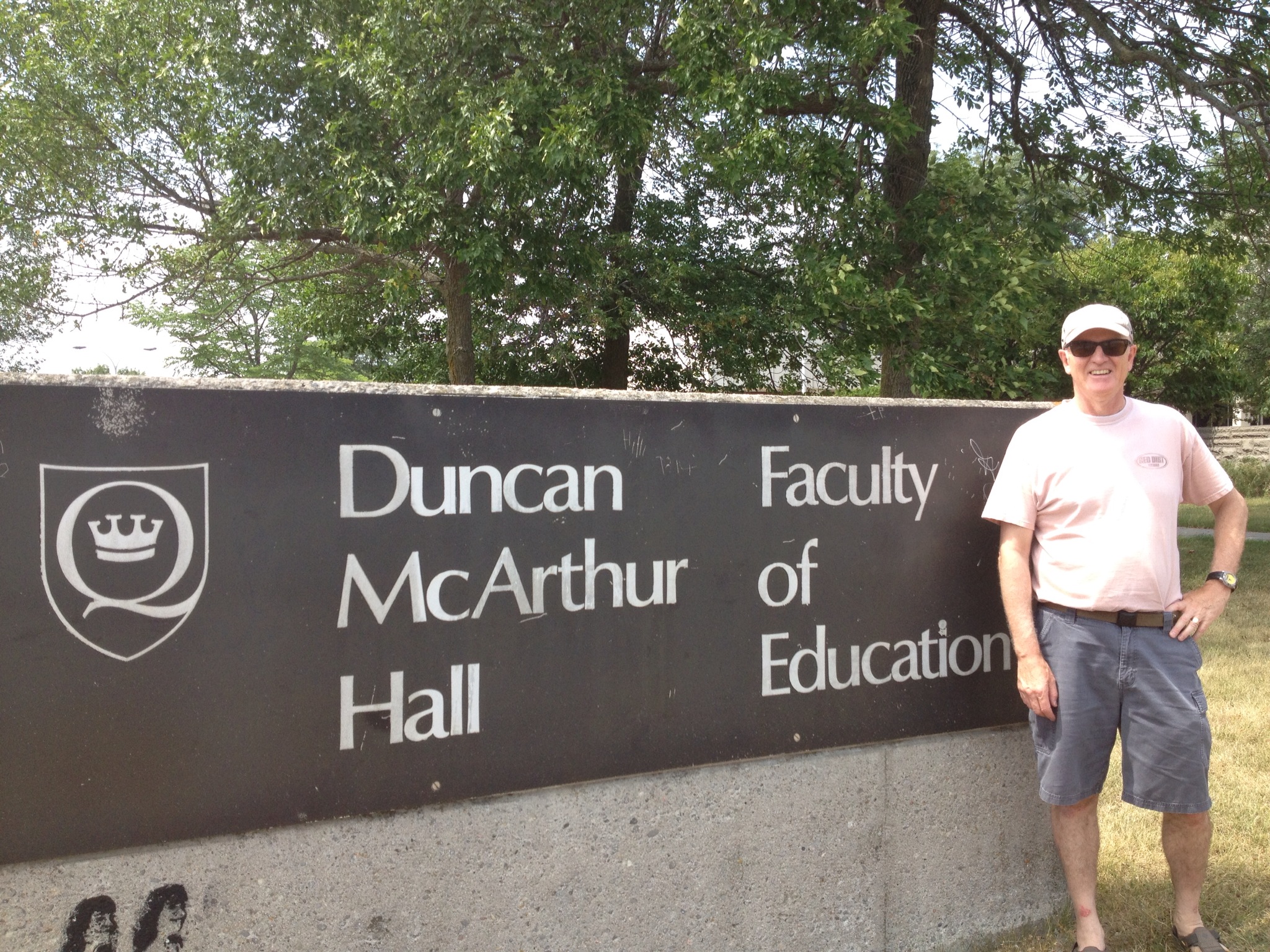 I just returned from my 1981 Teacher’s College Reunion. Our class of 20 were hand picked in 1980 to inaugurate a new program at Queen’s University’s Faculty of Education, also called Duncan McArthur Hall, in Kingston, Ontario. We were OEE 1981- Outdoor and Experiential Education- and we started our program in the spring of 1980, wrapping up in May of 1981 on an alternative education study tour of the North East US and Canada. We had spent 13 months together, and we became quite a dynamic, connected, and supportive group. We shared a passion for the outdoors, learning and teaching. We were joined in the fall of 1980 by another 20 students, who contributed even more to the amazing skills and knowledge of the original group. Many of us became educators, some school administrators, some lawyers, police officers, trainers, a priest and even a few outdoor educators!
The group shared many similar values, and each person brought a different experience and skill set to the group. We learned a lot of skills one from another, as well as knowledge. Some were expert paddlers, some wilderness leaders, rock climbers or naturalists. Others came with a wealth of experience working with child or adult learners. Many had travelled abroad, one had sailed part way around the world. With this amazing diversity of skills, we built the most amazing personal learning network, because we challenged one another to reach the skill level of each others’ area of expertise. And learn we did.
We were the basis of today’s PLN because we were a group of PEOPLE that supported one another to learn, the key here being people! The most important part of a PLN is the PEOPLE from whom you learn, not the technology or medium through which you learn it! This raises the point that as learners, we need to make sure we have people in our PLN to whom we relate well, who are supportive and connected.
Who is in your PLN? What connection do you have with them? How will you connect with them? What can you learn from them?
Our group held our reunion in the wilderness of northern New Brunswick, in the exact same place where we set off on our careers over 31 years ago. We’ve kept in touch over the years, and met on occasion to catch up. As our group reminisced, we found that we continued to share many values and passions for learning that we did at the beginning of our careers. It was people who made the difference. They always will.
I just returned from attending the Elementary Teachers’ Federation of Ontario Online Instructor’s Conference in Niagara Falls. All the attendees teach other teachers online, helping them to improve their qualifications. What happened at this conference that was different from most that teachers attend? Imagine some of the most creative, organized, talented, empathetic, knowledgeable people in the profession, from all across the province, and they were in the room. Now imagine that you could network and learn from the best of the best. That’s what happened at Innovate 2012.
I was honoured by being asked to present two workshops. The first was on using synchronous tools to improve the online experience of course candidates. In the second presentation I helped instructors discover the power of Social Media and Web2.0 tools to enhance their courses. The eagerness with which attendees grabbed onto new strategies and tools for their courses, such as Diigo and Twitter, and the extraordinary ideas that people shared with one another, both formally and informally, were powerful.
As I mentioned in my sessions, we are creating networked learners and we need to share. As Dean Shareski is so often quoted, “We are what we share.” There was some serious sharing going on, that each one of the conference participants benefitted from. I know I did.
What learning will we share with our colleagues back at our schools? How will we conduct our online AQ courses differently in light of our new skills and knowledge? How will we continue to build our Personal Learning Networks and share our expertise with our fellow instructors? Encourage our fellow ETFO AQ Instructors to look at the shared presentation handouts posted in our D2L Forums. Keep up with our new Twitter followers. Follow the Twitter hashtag #etfoaqinstr. Email and support one another.
We created change in two days. Let’s keep the change moving forward.
Here are my two presentations for anyone to view:

