Canadians and Social Media…eh!
Drive
I have just started reading Daniel Pink’s “Drive.” If you haven’t heard about Pink, or his other books (A Whole New Mind is a must read), you may want to look at this, and then head to your nearest library or bookseller. Pink explodes the myths about what motivates us. Have a watch.
This post is a discussion of the self-assessment I did for one of my many Wilkes Projects. I chose one from my first course, a Google Earth Virtual Field Trip for the course EDIM 508- Digital Media in the Classroom. I completed a rather unique and, I thought at the time, original, use of this kind of project. I chose to map out a Grade 7 novel, Remote Man, that I had used with my students. Author Elizabeth Honey had collaborated with me a number of times to create a live, online discussion with my students about the book. It seemed natural to explore this story using Google Earth. I blogged about this before in 2008. Later on, I polished the virtual field trip when I discovered a website, GoogleLitTrips.org, that promoted the use of Google Earth as a way to teach literature. I was thrilled that my work was published. This kind of reward far outweighs the grade received from my Wilkes instructor or my own self-evaluation here!
The Rubric I chose was one of the samples provided and was a General Rubric for Multi-Use Projects, and includes a long list of criteria areas, as well as criteria unique to certain types of projects, including multi-media, Powerpoint and Google Earth field trips. Since it included the project type I chose to evaluate, it seemed a good fit.
http://docs.google.com/View?id=dgd6fk65_6hshttsr3
I chose a limited number of criteria to self-evaluate my work:
- Multimedia Components
- Descriptive or narrative
- Shows evidence of pre-writing; well structured; does not ramble; length is appropriate and shows some editing. Mark: A
- Google Earth tour-Tour has 8 placemarks; connected with the GE path tool; displaying a photo ,a brief description, and a link or embedded material. Mark: A- due to GE path not used
- Descriptive or narrative
- Required Elements
- Deep Reasoning & Understanding- The Rubric cited requires that teachers apply specific criteria that would be in their Assessment Plan for evidence of learning. My evidence is the fact that I elaborately connected material in the book Remote Man, information and insights of the author, my own personal experiences and insights, about the story, and its meaning, in a unique and creative way. My Mark: A
- Learning Targets-
- Factual Information-facts in the first 2 sections show a detailed and thorough understanding of concepts, processes, problems, benefits, or issues. Mark: A
- Mechanics of writing-Mark: A
- Ethical use of images and music;
- All images and music are from CC sources, used with written permission, or original. Mark: A
- Effectiveness and Impact
- Thoughtful, Persuasive, Creative, Original, Compelling, Emotional appeal
- 5 or 6 criteria are present in any or all of the parts of the presentation- Mark: A
- Thoughtful, Persuasive, Creative, Original, Compelling, Emotional appeal
- Injection of Personality
- The personality of the writer is evident through his/her use of humor, personal experiences, and development of a personal point of view. Mark: A
So this is the point where the Rubric ends. There needs to be some other criteria for this specific project, but the ones above, chosen from the example Rubric, certainly cover most of the product.
Here are some Google Earth skills and process criteria that would be useful for the evaluation, some of which were included in the original Course EDIM 508 Rubric for the project and should be included, in some form, in a student Rubric.
- Instructional design (clear instructions, logical flow between placemarks, etc.)
- Insertion of images
- Integration of content in placemarks
- Application- used the learning is a unique or original application
Mobiles in the Mountains Redux
In my recent post about how Australian teacher Jarrod Robinson used mobile phones on field trips, I referred to Robinson’s well crafted Blog that is really worth following. I am pleased to say that has written a follow up to my questions about his Grampian Mountain Project on his Blog, explaining some of the challenges and successes of the project.
Check it out!
Digital Portfolio- The Rodcast “Wiki Edition”
Here is a link to The Rodcaat- Wiki Edition which is my continuing Digital Portfolio of the 10 classes in the Wilkes Instruction Media Program.
Mobiles in the Mountains
I noted that a number of the more innovative projects where mobile phones are used (mobile, by the way, is the term used almost everywhere but North America) is in Australia, from the list we were given for this analysis. I immediately keyed in on Jarrod Robinson’s wonderful class records of their trip to Victoria’s Grampian Mountains National Park. Australia is a geographic wonder, and a short (sometimes very long!) drive in any direction often leads one to very unique environments in which to explore and learn.
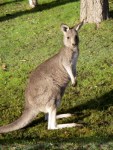
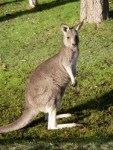
Wow! The Grampians (named after a range of mountains in the highlands of Scotland) are an incredibly unique geological feature of the Victorian landscape, and one of the many reasons I really liked this project was my personal familiarity with the area. We lived in Victoria in 2007 and as as family, we took four trips to the Grampians combined, due to its unique environment. Ironically, it was 6 months into our year in Australia before I encountered a wild kangaroo. That happened on my first visit to The Grampians, where hundreds wandered freely in the bush and in the villages, like the Joey pictured above. Students grasp the unique connections between the geography and biology of a place when they are evident firsthand.
Every school child in Australia has an equal opportunity to go to “school camp” and my youngest son spent his week in the Grampians on a similar trip to the one featured in Robinson’s Victorian Certificate of Education Year 11 Outdoor and Environmental Studies Trip. This course is one of the courses that can be taken for high school completion for year 11 in Victoria.
Robinson’s classes recorded audio blogs during the experience, captured photographs, and then created Slideshare Presentations to synthesize their learning after the trip, which are embedded in the class Blog page.
Coincidentally, our school trip leaves Monday morning for a cultural and historical learning experience in Quebec City, a UNESCO world heritage site and the only walled city in North America. Students “peuvent pratiquer le français” and be immersed in “the joie de vivre” of Quebec. We’ll be broadcasting live fom my iPhone back to the school on Qik.com
I contacted Robinson in a variety of ways, knowing that he is in the middle of report writing mode at the school year’s halfway mark in Victoria, an extremely challenging and difficult element of the Victorian school teacher’s job. He acknowledged my inquiry on Facebook and then later, answered the edited questions I posed:
- How did you mange to convince the Principal/Headmaster to allow the use of phones by students?
- Were there any other policy obstacles you had to overcome before doing this?
- What was the parental reaction to this project?
- Were there any other challenges (technical or otherwise) that you had to deal with?
- In order to convince the principal I showed her the actual software and idea in action. She was then in a position to see the potential and realise how valuable it would be for the learning experience. She gave me permission to trial it as long as it was under the direct supervision of myself.
- Our school policy at the time was against use of mobile phones within class. This trial was an exception to see just how they could be used for good.
- The parental reaction was quite positive, parents were able to log onto the website and listen to their kids blogs as they were happening. The students reactions were only temporary, the students thought it was cool but in the end their mobile phones are everyday items to them. I didn’t expect them to make a fuss over what they see is normal technology. As teachers we shouldn’t expect them to think these sorts of things are amazing….because in our students world’s…they are just normal…
- The only potential challenge I faced was ensuring that all students had access to a mobile phone. So before deciding on the project I surveyed students to find out the data and then based my decision on this. It turned out that all students did have access, which meant I could safely go ahead with the project.
Jarrod Robinson also has an excellent, award winning Blog in which he records other innovative methods for using technology in Physical Education, Outdoor Education, and Environmental Studies, all areas in which I have a great interest. He also presents at various Australia conferences and his innovative integration of technology into his classes is noteworthy. I’ve added him to my Google Reader list. He can be contacted in any of the following ways:
Email – robinson.jarrod.j@edumail.vic.gov.au
Twitter – mrrobbo
Skype – robbo6486
While checking the EdTech Talk calendar, I noticed a webinar for Tuesday this week that looked interesting. The timing was off, however. I just could not make the EdTech webinar schedule sync with mine, so I looked at the Classroom 2.0 list that I receive by email. I have, on occasion, sat in on one of these and they’ve been very informative. There was an announcement there about the Learn Central webinars for the week. Turns out they were offering one in just a few minutes time Monday night so I set up the MacBook Pro with headphones and clicked the link and got ready to go.
Skype an Author is a Wetpaint Wiki set up by an author and a Library media specialist. Mona Kerby and Sarah Chauncey, author and librarian, respectively, had an opportunity for one to meet the other on a school visit. In a subsequent year, the author visited via Skype, and the idea took off from there. Their Wiki links classroom teachers to authors and assists them in setting up virtual visits. According to the site, “The mission of the Skype an Author Network is to provide K-12 teachers and librarians with a way to connect authors, books, and young readers through virtual visits.”
The medium for Learn Central is Elluminate Live! a medium with which I am now quite familiar. I had hoped it would be via another delivery method to give me a different experience. The event was hosted by another person and the guests explained how their idea came to fruition and how it works.
There were lots of questions in the chat box in Elluminate as the audience became engaged in the idea of bringing authors to the children, and how it could work in various schools and settings. The presenters went through some “dos and don’ts” for arranging a visit, setting up the technology and prepping the audience for the exchange between students and the author.
This is an excellent example of the type of webinar that can really bring the outside world into the classroom, with lots of practical suggestions for a successful session. This is the kind of presentation that encourages teachers and allows them to explore the possibilities of virtual visits. Kids are naturally curious about books and authors and reluctant teachers (those who might be intimidated by technology) might be ready do something like this if they were to see this done successfully by a colleague. With over 200 authors on the list of available “Skype an Author” participants, there is probably one that will fit your grade and program. A quick search of the author list showed numerous Canadian authors, lots of US based authors, as well as a number of international authors. The choices are very broad. The medium for the exchange is also negotiable- it could be Skype, Elluminate, Adobe Connect or iChat. Short sessions are free, and longer ones may involve a fee.
Ironically, I arranged an author “visit” using a private chat room back in 2004, before Skype and its cousins existed. Australian author Elizabeth Honey met with my class on more than one occasion to discuss her book Remote Man. Having a live author communicating with students is really an engaging, motivating experience, especially from so far away . This was echoed in the comments by the presenters.
Every time I participate in webinars I find that there is some great idea or significant learning that can be used in a classroom context. I have, as mentioned, tried a few different webinar venues and will, no doubt, follow some more, perhaps over the summer when I have more time (and after finishing this Wilkes course, which is my last!).
Teaching Science next year, I intend to incorporate a virtual visit by a scientist, perhaps an astronomer or Canadian astronaut, to parallel our Space unit. But an author visit could be added to the language program or social studies program by our Grade 6 team next year.
The Skype and Author webinar archive can be viewed in Elluminate here.
Phone film inspiration
Just saw this film and had to put it up here! It may inspire my classmates who are working hard on creating a film entirely on their phone.

